ZigBee Sensor Network
Version 1.0 of an ongoing sensor-logging series - preceded by an early prototype, Weather Station, succeeded by ESP32 Sensor Node (v2.0).
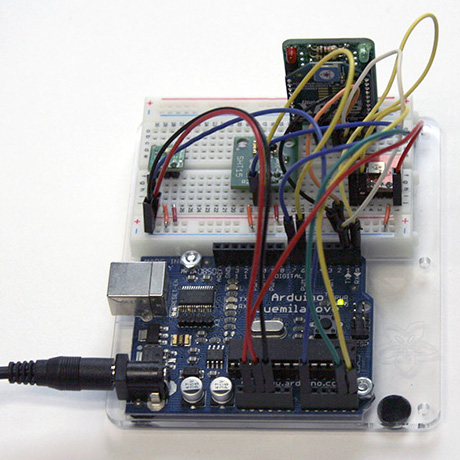
The same breadboard as the Weather Station prototype, with an XBee radio added on top
The Weather Station prototype needed a laptop in the room: an Arduino read the sensors and
wrote the values out over a serial cable to a computer running Processing. That wired connection
wasn't feasible for an unattended deployment - I didn't want to leave a laptop behind. A full Wi-Fi
stack was out of reach at the time too: there were Wi-Fi modules for Arduino, but the
microcontroller was just hopelessly underpowered for that stack. So starting around 2012, I
dropped the laptop entirely and used XBee radios instead: each device got one instead of a
serial cable, reporting wirelessly to a ConnectPort X2 acting as the network's ZigBee
coordinator/gateway. Since the XBees ran in transparent AT mode, a device's own sketch didn't
need any radio-specific code at all - it just wrote to Serial exactly as if it
were still wired to a laptop, and the XBee handled getting that data off-site.
Radios
Three terms get used interchangeably but aren't the same thing:
- 802.15.4 - the IEEE standard defining the physical/MAC radio layer only: low-power, low-data-rate, short range.
- Zigbee - a full networking/application stack (routing, addressing, mesh self-healing, coordinator/router/end-device roles) built on top of 802.15.4.
- XBee - Digi's (formerly MaxStream, acquired by Digi) brand name for radio modules; it doesn't by itself say which protocol stack is running on the module.
XBee modules come in two series:
- Series 1 (XBee/XBee-Pro, Freescale radio) - implements raw 802.15.4 only: point-to-point / point-to-multipoint, no mesh.
- Series 2 (XBee ZB / XBee-PRO ZB, Ember radio) - implements the full Zigbee stack on top of 802.15.4, which is where mesh networking and the coordinator/router/end-device roles come from.
Only Series 2 did what I wanted here - mesh, not just point-to-point.
Gateway
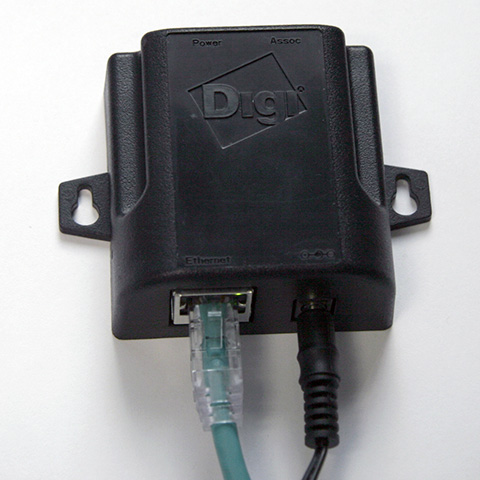
ConnectPort X2
All XBees had to be configured as "ZIGBEE ROUTER AT" - firmware number 22xx was the only one relevant here. Settings:
| Setting | Command | Value |
|---|---|---|
| PAN ID | ID | AAAA |
| Scan Channels | SC | 1FFE |
| Channel Verification | JV | 1 |
| Destination Address High | DH | 0 |
| Destination Address Low | DL | 0 |
The flagship deployment was the weather station at the coop (Dryden, NY) - the same location the Weather Station prototype had been reporting from. Several other devices ran on the same ZigBee/ConnectPortX2 backbone:
SparkFun Weather Board
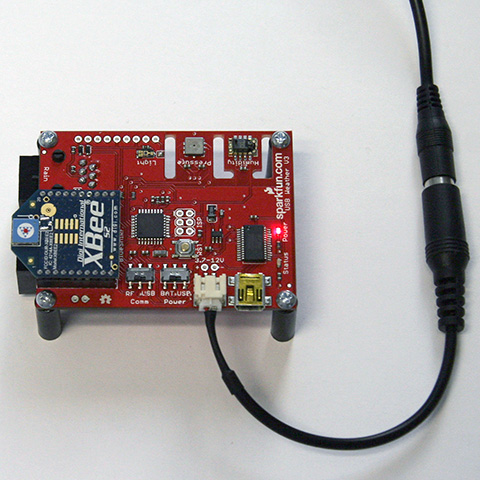
Weather Board V3
SparkFun's USB Weather Board V3 put the Weather Station prototype's same two sensors - SHT15 (temperature/humidity) and BMP085 (pressure) - on one integrated board running SparkFun's own stock firmware, instead of loose breakout boards wired to a bare Arduino. This was the coop's first device:
Arduino Fio
Everything else on this network - every device besides the Weather Board itself - was built around a Funnel-flavored Arduino Fio: its form factor has a built-in XBee socket, so a new sensor node was just a Fio, an XBee, and whatever sensor was being wired up that time, no separate radio-adapter wiring needed (see Arduino Fio Programming). The Fio was also a clean break from the Weather Station prototype's mixed-voltage mess: it's a native 3.3V device, matching the XBee radios' own 3.3V logic directly, so there was no more juggling 5V/3.3V sensors or level shifters on the microcontroller side. The coop grew into a proper multi-device station this way, one Fio per role, alongside a separate installation at BUILDlab:
- Temperature6 (BUILDlab, Dryden, NY) - six 1-Wire (DS18B20) sensors read in a vertical line, plus a small LCD for local readings: 6 Temperature Sensors (historical - BUILDlab stopped reporting in 2014). Source: Temperature6Gateway.pde.
- Temperature Grid 45 (the coop) - three grid modules (A, B, and C): Grid 45
- ElitePro Power Meter (the coop) - appliance power consumption (volts, amps, watts): Power Meter
- Solar Radiation (the coop): Solar Radiation
- c-cub.es Weather (the coop) - SHT15 (temperature/humidity) and BMP085 (pressure), fed weather data to c-cub.es, no report page of its own
The coop as a whole - Weather Board included - stopped reporting in 2012.
Weather Board firmware and datasheet: Weather_Board_3.pde, USB Weather Board V3 datasheet. Temperature6's gateway sketch: Temperature6Gateway.pde.
What Came Next
The whole ZigBee generation eventually went dark - the coop and BUILDlab stopped reporting
years apart (2012 and 2014), and a batcave weather board on this same architecture
went dark in 2016 too, its report sitting untouched for a decade until the
ESP32 Sensor Node project (v2.0) picked the same idea back
up in 2026, native Wi-Fi instead of a ZigBee/gateway hop, reporting to that same station's
prefix again.