Spiral Flower Generator
○∧
○∨
Δr
Δθ
× 360°
−1
Δθ/frame
Sources
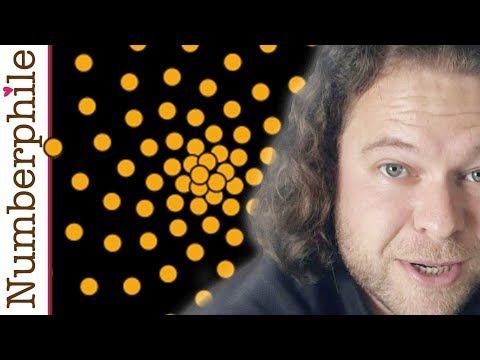
This web page was heavily inspired by the Numberphile video The Golden Ratio (why it is so irrational):
Algorithm
The Spiral Flower pattern is generated by placing circles along an Archimedean Spiral:
- It uses the polar coordinate system, which defines a point by a distance r (radius) from the pole (origin) and an angle θ (theta) from the positive x-axis, represented as (r, θ).
- This system is often used for circular symmetries, whereas Cartesian uses (x, y) for horizontal and vertical distances.
- For each stepᵢ, each circleᵢ sits at (r, θ)ᵢ = (i × Δr, i × Δθ) and the circle's radius grows linearly from ○∧ to ○∨.
- The polar coordinate (r, θ) is converted to Cartesian (x, y) coordinates using (x, y) = (r × cos(θ), r × sin(θ)) (the inverse conversion (r, θ) = (√(x²+y²), arctan(y/x)) is not used here).
- The value of Δθ (with θ = frac(Δθ) × 360°) controls the pattern - rational fractions produce spokes, irrational ones fill the spiral more evenly.
- How uniform the packing is depends on "how irrational" the number is - an irrational number with a good rational approximation will still create easily recognizable spokes, like π ≈ 22/7 or 355/113. The golden ratio frac(φ) ≈ 0.618 gives the densest uniform packing - the sunflower pattern found in nature.
This page was created with Claude Code.