AVR
This page will not explain why you should use AVR chips or why PIC is better/worse. It is more the other way around - if you want to use an AVR chip - which one is a good choice. Capabilities and size are basically the main factors.
ATtinyX5
With 8 pins these are the smallest chips. Advertised with 6 digital I/O lines, but I strongly recommend not to use the reset line - which means 5 usable I/O lines. Older chips (like ATtiny11, ATtiny12, ATtiny13, ATtiny15, ATtiny26) should not be used. I do not use the ATtiny13A either, because the fusebits are different and the memory is pretty small (I rather spend the additional 20cents to get a ATtiny25.
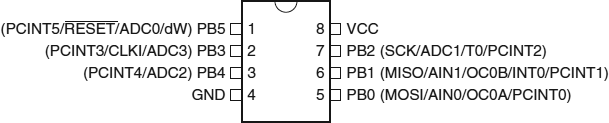
Flash |
RAM |
EEPROM |
|
| ATtiny13A | 1k |
64 |
64 |
| ATtiny25 | 2k |
128 |
128 |
| ATtiny45 | 4k |
256 |
256 |
| ATtiny85 | 8k |
512 |
512 |
ATtinyX4
With 14 pins these are very powerful chips, best for most projects. More IO pins than the ATtinyX5 and just a few less than the ATtiny2313.
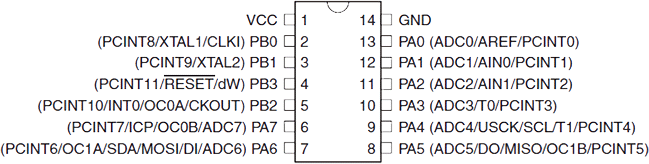
Flash |
RAM |
EEPROM |
|
| ATtiny24 | 2k |
128 |
128 |
| ATtiny44 | 4k |
256 |
256 |
| ATtiny84 | 8k |
512 |
512 |
ATtiny2313, ATtiny4313
ATtiny2313
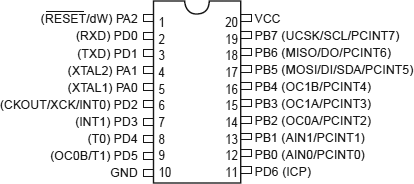
Flash |
RAM |
EEPROM |
|
| ATtiny2313 | 2k |
128 |
128 |
| ATtiny4313 | 4k |
256 |
256 |
ATmegaX8
The Arduino line.
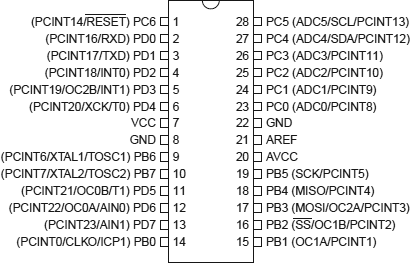
Flash |
RAM |
EEPROM |
|
| ATmega48PA | 4k |
½k |
¼k |
| ATmega88PA | 8k |
1k |
½k |
| ATmega168PA | 16k |
1k |
½k |
| ATmega328P | 32k |
2k |
1k |
ATmegaX4
ATmega644P
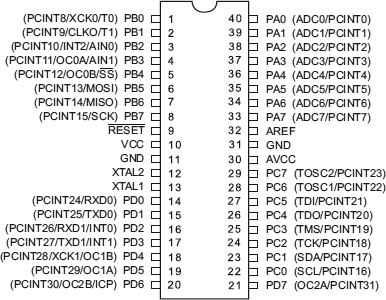
Flash |
RAM |
EEPROM |
|
| ATmega164P | 16k |
1k |
½k |
| ATmega324P | 32k |
2k |
1k |
| ATmega644P | 64k |
4k |
2k |