1-Wire
Overview
1-Wire devices share a single data line (plus ground, and optionally power -- most devices can also run "parasitically" off the data line itself). Each device has a unique 64-bit ROM ID burned in at the factory, which is what lets many devices share that one bus and still be addressed individually.
The bus should be wired more or less linearly, not as a star, and the total length has limits. In theory the 64-bit ROM ID space allows for unlimited devices on a bus, but in practice bus loading and timing make somewhere around 20 devices a more realistic ceiling. Devices can be found with a search/scan, but the algorithm walks the ROM ID space as a binary tree, so devices show up in an order determined by their ROM IDs -- not by how physically close they are to the microcontroller.
You can talk to 1-Wire devices two ways: bit-bang the protocol yourself with a 3rd-party library, or use a bridge chip that handles the protocol details in hardware and exposes the bus over I2C instead -- which many microcontrollers already support natively, or at least have better-supported libraries for.
DS2482
I2C to 1-Wire Bridge, comes in two flavors: the single-channel DS2482-100 and the 8-channel DS2482-800. Both are interesting for the same reason -- no bit-banging and no 3rd-party libraries, since the 1-Wire timing is handled by the chip and driven over a standard I2C bus.
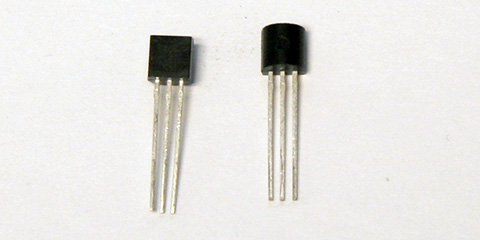
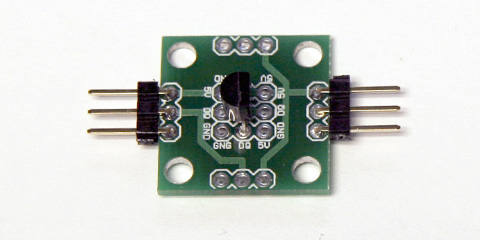
DS18B20, DS1820, DS18S20
The most popular 1-Wire sensor is probably the DS18B20 (DS1820, DS18S20) family. The DS18B20 is the successor of the DS1820 and DS18S20 and should be used for all new projects. They are low cost, high precision digital temperature sensor. The documentation for the DS18B20 is here.